 3 months ago
216
3 months ago
216
.jpeg)
.jpg)
TL;DR
Your existing customers are the best affiliate source. They already trust your product and carry word-of-mouth credibility that cold-recruited partners can’t match.
- Best enrollment method: Post-purchase invite at the thank-you page (highest signup rate)
- Second best: Post-delivery email sequence (customer has used the product)
- Commission approach: Offer customer-affiliates 2–5% above your standard rate
- Key advantage: Zero recruitment cost, higher referred-traffic conversion
- Start here: Implement post-purchase enrollment + email sequence — covers most convertible customers
Most Shopify merchants search for affiliates outside their store — cold-pitching bloggers, scrolling Instagram hashtags, joining marketplaces. The best affiliate source is already sitting in your Shopify customer list.
These are people who paid for your product, used it, and came back. When they recommend you, their audience listens.
The data backs this up. 88% of people trust advice from friends and family over any other channel, and only 2% consider traditional ads influential in their buying choices .
Customer-affiliates turn that trust into a trackable revenue channel, with zero recruitment cost and higher conversion rates than cold-recruited partners.
This guide covers six enrollment methods ranked by effectiveness, the right commission setup for customer-affiliates, and setup steps you can implement.
Why Do Customers Make Better Affiliates Than Influencers or Bloggers?
Customer-affiliates carry one advantage that cold-recruited partners can’t replicate: genuine product experience backed by personal trust.
They cost nothing to recruit, convert referred traffic at higher rates, and already live inside your Shopify data.
That advantage breaks down into four areas — trust, conversion, cost, and data — where customer-affiliates outperform cold-recruited partners.
➡️ Authentic experience drives higher trust
A customer who paid for your product and uses it daily promotes with a trust that a gifted-product review can’t match.
Their audience knows the recommendation is real, not paid, not scripted, not driven by a free sample.
➡️ Referred traffic converts better
Wharton research found that referred customers carry a 16% higher lifetime value. When the referral comes from a real buyer, that trust advantage compounds.
➡️ Zero recruitment cost
Cold outreach means hours of DMs, emails, and follow-ups. Customer enrollment runs on autopilot.
A post-purchase invite appears, the customer signs up, and they start sharing. No negotiation, no flat fees.
➡️ Already in your Shopify ecosystem
You already have their purchase history, order value, and email — enough data to spot your best candidates and invite them first.
SilverCeuticals , a health and wellness brand, built their affiliate base partly by getting existing customers to promote products. The brand now supports over 1,100 active affiliates and drives close to 30% of total revenue from the channel.
The tradeoff isn’t one-sided. Customer-affiliates win on trust and cost, while cold-recruited partners win on reach and scale.
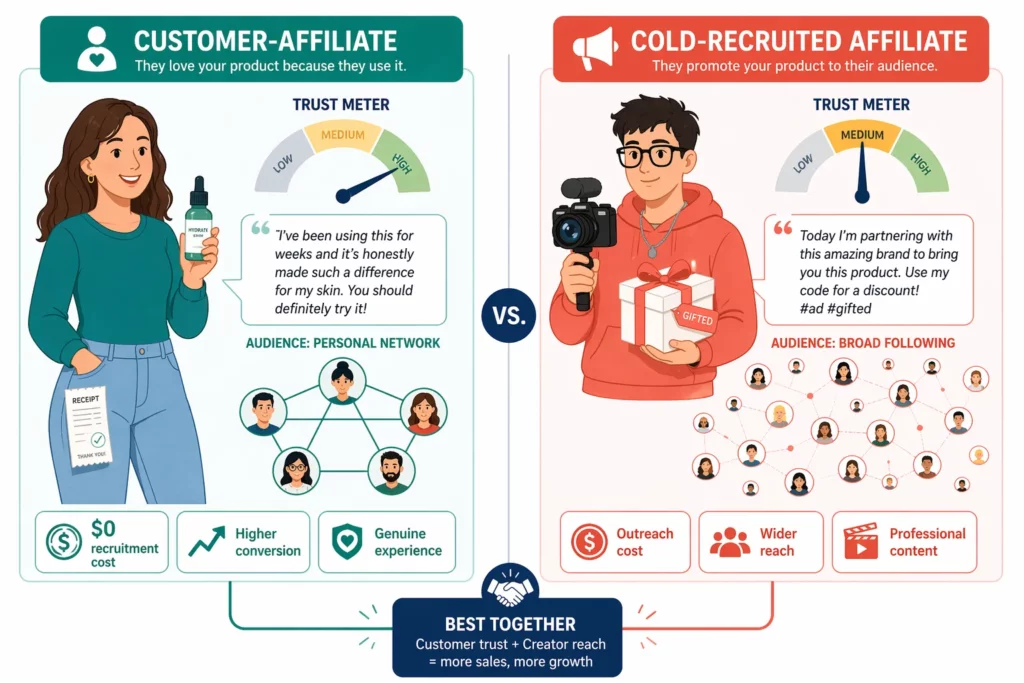
| Factor | Customer-Affiliate | Cold-Recruited Affiliate |
| Product experience | Genuine — paid and used | Varies — gifted, tested, or none |
| Audience trust | High — personal recommendation | Medium — content-based endorsement |
| Referred traffic conversion | Higher — warm, trust-driven audience | Lower — broad, mixed-relevance audience |
| Recruitment cost | Near zero — automated enrollment | Moderate — outreach time + tools |
| Scale potential | Limited by customer base size | Unlimited — global partner pool |
| Content quality | Authentic but often amateur | Professional but may lack authenticity |
| Typical reach | Small — personal networks | Large — blog/social audiences |
| Best for | Word-of-mouth, niche, repeat-purchase brands | Volume, brand awareness, SEO content |
What Are the Most Effective Ways to Convert Customers into Affiliates?
Six enrollment methods exist, but two (post-purchase enrollment and post-delivery email ) capture most convertible customers.
You can first start with those, then layer in extra touchpoints as your program matures.
Each method’s success depends on timing. Reaching customers at peak excitement can produce the highest signup rates.
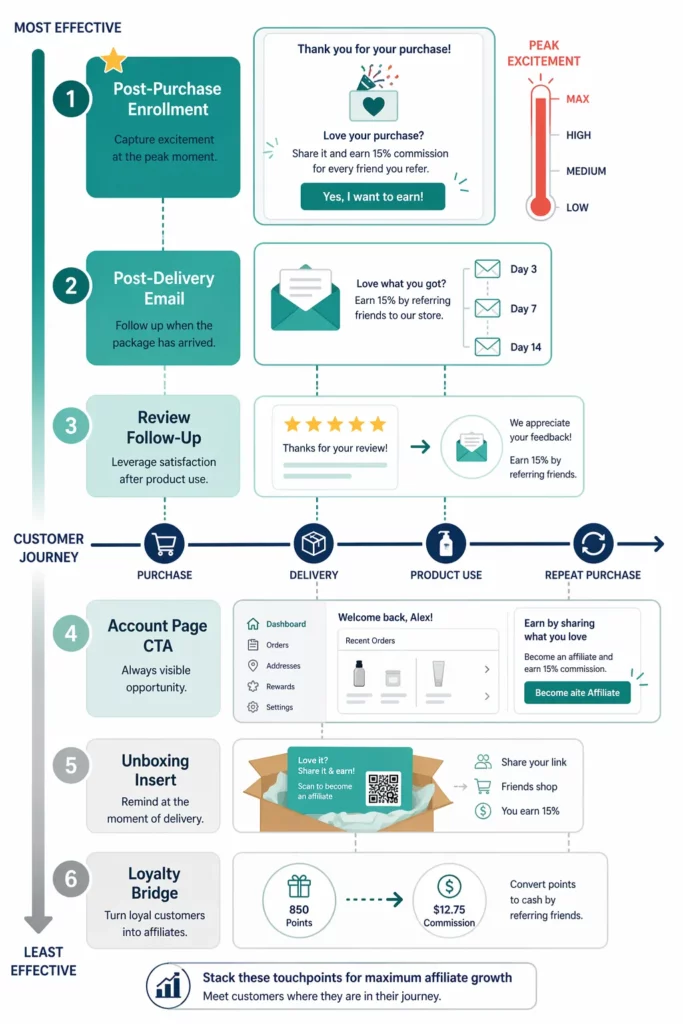
| Rank | Method | Effectiveness | Effort | Automation |
| 1 | Post-purchase enrollment | Highest | Low — one-time setup | Fully automated |
| 2 | Post-delivery email sequence | High | Low — one-time setup | Fully automated |
| 3 | Review follow-up trigger | Moderate | Medium | Semi-automated |
| 4 | Account page affiliate CTA | Moderate | Very low | Passive |
| 5 | Unboxing insert card | Low | Medium — print cost | Manual |
| 6 | Loyalty program bridge | Moderate | High — integration | Automated |
Post-Purchase Enrollment (Highest Conversion)
The moment right after purchase is when customer excitement peaks. They just committed money, they’re excited about the product, and they’re still on your site.
That’s your window.
A post-purchase invite on the thank-you page catches customers at peak excitement — zero friction and immediate access to sign up.
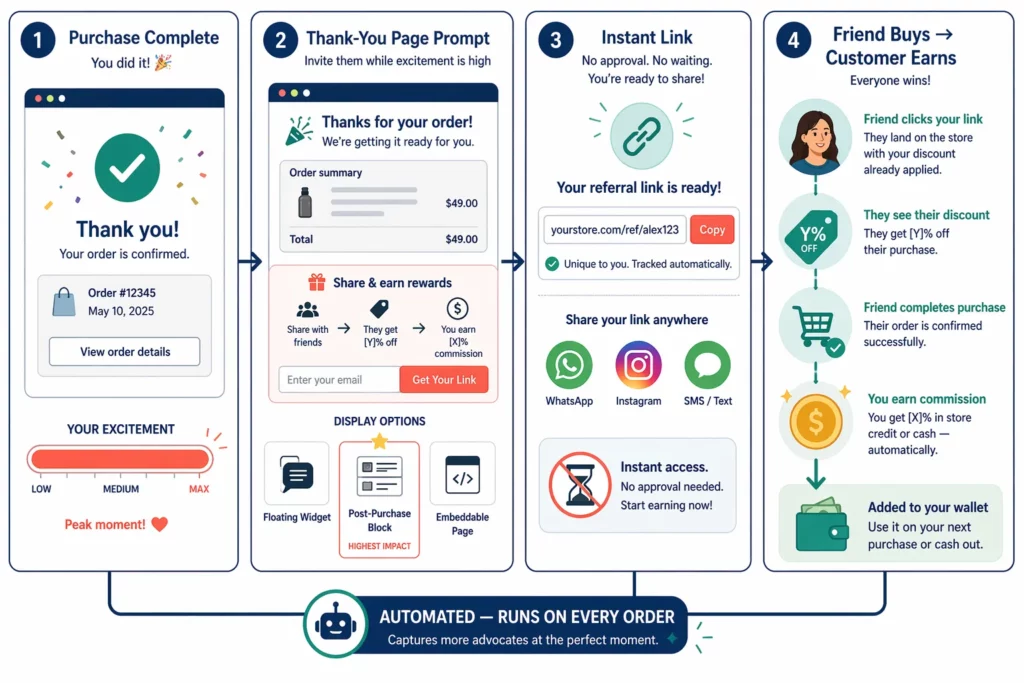
You need one thing on the thank-you page: a referral prompt that gives each buyer a personal link and pays store credit when a friend purchases.
In UpPromote, you’ll find Customer Referral — turn it on once and it runs on every order.
That two-stage pipeline means you run casual referrals and serious affiliate recruitment side by side. The best customers graduate on their own.
The moment right after purchase is when customer excitement peaks. They just committed money, they’re excited about the product, and they’re still on your site.
That’s your window.
You need one thing on the thank-you page: a referral prompt. The customer enters their email, gets a unique referral link on the spot, and shares it with friends.
When a friend clicks the link, they see a discount at checkout. When that friend buys, the original customer earns store credit, either a flat amount per order or a percentage of the sale. .
No affiliate application, no approval wait. The customer is sharing within seconds of checkout.
In UpPromote, you’ll find this under Customer Referral . It runs as a separate program from your main affiliate track with its own customer list, referral tracking, and analytics dashboard.
There are three display options to choose: a floating widget on any page, a post-purchase signup block on your thank-you page , and an embeddable landing page for any store page.
In which the post-purchase block is the highest-impact placement. It catches buyers at peak excitement with zero extra clicks.
Post-Delivery Email Sequence
Post-purchase enrollment captures customers in the excitement window, but not every buyer signs up on the spot. A post-delivery email sequence catches the rest, timed for the moment the customer has tried the product and formed a view.
The ideal timing is three to seven days after delivery. The customer has unboxed, tested, and started forming views. Happy customers are ready to share.
A three-email sequence works best:
- Email 1 (Day 3 post-delivery): Check satisfaction. If happy, seed the affiliate idea. If unhappy, route to support — not affiliate enrollment.
- Email 2 (Day 7): Direct affiliate invite with a clear commission offer, signup link, and what their friends get.
- Email 3 (Day 14, non-openers only): Short reminder — “Did you see this? Still interested?”
Here’s a template for the invite email:
Subject: Earn [X]% sharing [Product] with friends
Hi [Name],
You recently received [Product]. Customers like you are why we exist — and now you can earn by sharing what you love.
→ Earn [X]% commission on every sale you refer → Get your own personal link to share → Your friends get [Y]% off their first order
It takes 30 seconds to sign up: [SIGNUP LINK]
No minimums. No commitment. Share when you feel like it.
[Brand Name] Team
Additional Enrollment Touchpoints
Post-purchase enrollment and email cover most convertible customers. These four touchpoints add extra signups once the foundation is running.
📌Account page CTA
Add a “Become an Affiliate” link in the customer account dashboard. Customers checking orders see the CTA and can sign up on their own.
📌Review follow-up trigger
When a customer leaves a 4–5 star review, trigger an automated email: “You love [Product] — want to earn sharing it?” Target only happy customers. Connect your review app (Judge.me, Loox) to your email platform to automate this.
📌Unboxing insert card
A physical card in the package with a QR code to your signup page. Memorable but adds print cost and is hard to track.
📌Loyalty program bridge
If you run a loyalty program (Smile.io, LoyaltyLion), offer top-tier members an upgrade path from points to cash commissions. This bridges loyalty into affiliate — but requires integration work.
What Commission Structure Works Best for Customer-Affiliates?
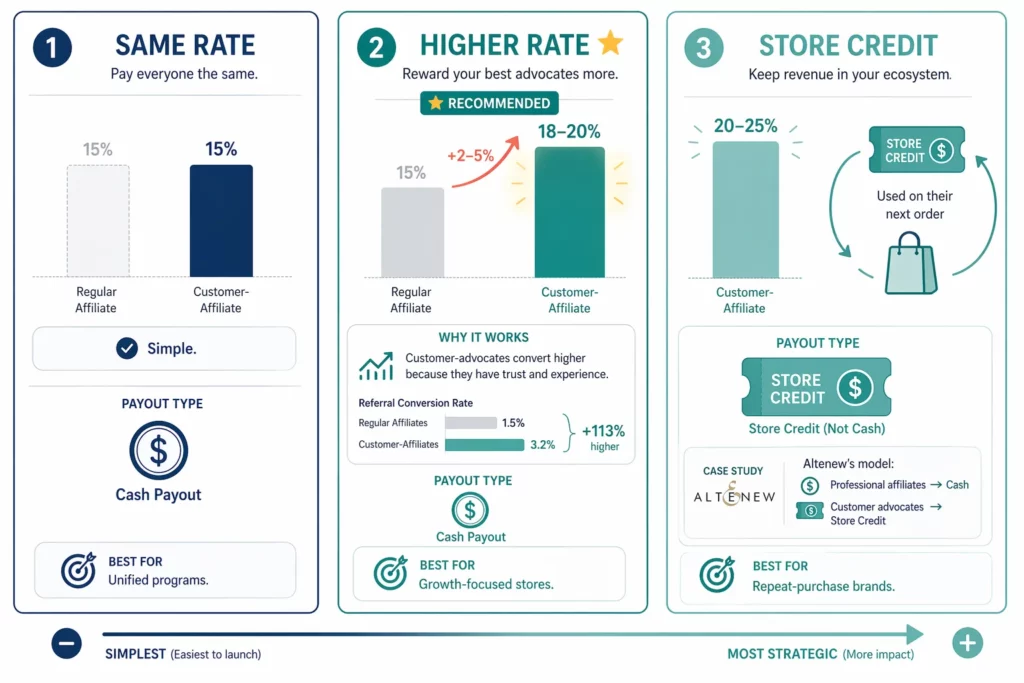
The recommended approach is giving customer-affiliates a slightly higher rate, 2–5% above your standard commission. They convert better per referral, so the higher rate pays for itself.
Three models below can work, and the right choice depends on your margins and whether customers buy from you more than once.
- Same rate as regular affiliates
The simplest option. Customer-affiliates earn the same percentage as all partners. Fair, easy to manage, and work for single-tier programs.
- Higher rate for customer-affiliates (recommended)
Set customer-affiliate commission 2–5% above your standard. If your regular program pays 15%, customer-affiliates earn 18–20%. Their referred traffic converts at higher rates, making each referral more profitable.
- Store credit instead of cash
Pay customer-affiliates in store credit rather than cash. For repeat-purchase brands — skincare, supplements, food — customers spend the credit on their next order, recycling commission into revenue.
The crafting brand Altenew runs exactly this split. Professional affiliates earn cash commissions, while customer advocates receive auto store credit payouts.
Affiliate apps like UpPromote lets you create a dedicated customer-affiliate program with store credit payouts, separate from your main cash program. The table maps each model to the situation where it fits.
| Approach | Commission | Payout | Best For |
| Same rate | Standard (e.g., 15%) | Cash | Simple programs, unified structure |
| Higher rate ★ | Standard + 2–5% | Cash | Growth-focused stores |
| Store credit | Standard + 5–10% | Store credit | Repeat-purchase brands |
What Changed in 2026?
Four shifts in the past year have made the customer-to-affiliate pipeline easier and more profitable. Each changes how Shopify merchants approach enrollment.
Post-purchase enrollment is now standard. A year ago, post-purchase affiliate invites were an advanced feature. In 2026, every serious affiliate app offers them. The question is no longer whether to enroll customers — it’s how quickly.
AI-powered customer scoring is emerging. Some platforms now score customers by purchase frequency and social following to predict who will promote. Targeted invites replace blanket enrollment.
UGC and affiliate content are converging. Brands now track customer content — unboxing videos, reviews, stories — as affiliate referrals. They pay customers for both the content and the sales it drives.
Store credit payouts are growing. More brands offer store credit instead of cash for customer-affiliates. Credit costs less than face value, and customers reinvest it into their next order.
Frequently Asked Questions
What percentage of customers will become active affiliates?
Most stores see a single-digit signup rate from enrollment touchpoints, and only a fraction of those signups promote. A store with 1,000 monthly customers might generate 10–20 active customer-affiliates — small in headcount but high in referral quality.
Do customer-affiliates create professional content?
Not usually. Customer-affiliates share on personal channels — Instagram stories, group chats, direct messages — with less polish than professional creators. That authenticity is the point. Providing product images, sample captions, and a short brand guide lifts content quality without killing the personal voice.
Should I auto-enroll all customers or use opt-in?
Opt-in is the safer default. Auto-enrollment maximizes signups but fills your list with inactive accounts and confused customers who never intended to join. Opt-in produces fewer signups with higher intent — people who chose to promote are more likely to follow through.
Do customer-affiliates need FTC disclosure?
Yes. Every affiliate — including customers — must disclose the relationship when promoting with an affiliate link. “#ad” or “I earn a commission” is the minimum. Include this requirement in your onboarding email and program terms. There are no exceptions for customer-affiliates.
Can I run a referral program and an affiliate program at the same time?
Yes, and most stores above $20K/month in revenue should. Referral programs handle casual sharing with store credit rewards, while affiliate programs handle serious promotion with cash commissions. Keep the two tracks separate with clear naming so customers know which one they’re joining.
Should I invite all customers or only VIPs?
Start by inviting everyone through post-purchase enrollment and email. Let the data reveal who performs. Customers who sign up, share, and drive sales are your VIPs — upgrade them with higher commissions or exclusive perks once their track record is clear.







.png)
.png)

.png)


 English (US) ·